


Is your device really PIS-only? QFI publishes new circular on placing on the market, putting into service and PIS-only status in Great Britain
A free 4-page guide to the MHRA's July 2026 clarification and what it means for your DORS registration, fees and UK Responsible Person records.
Published by Haroon Atchia, Technical Director of Quality First International - 24 September 2026
Quality First International (QFI) has published a free 4-page regulatory circular explaining the difference between placing on the market (POM), putting into service (PIS) and PIS-only status for medical devices in Great Britain.
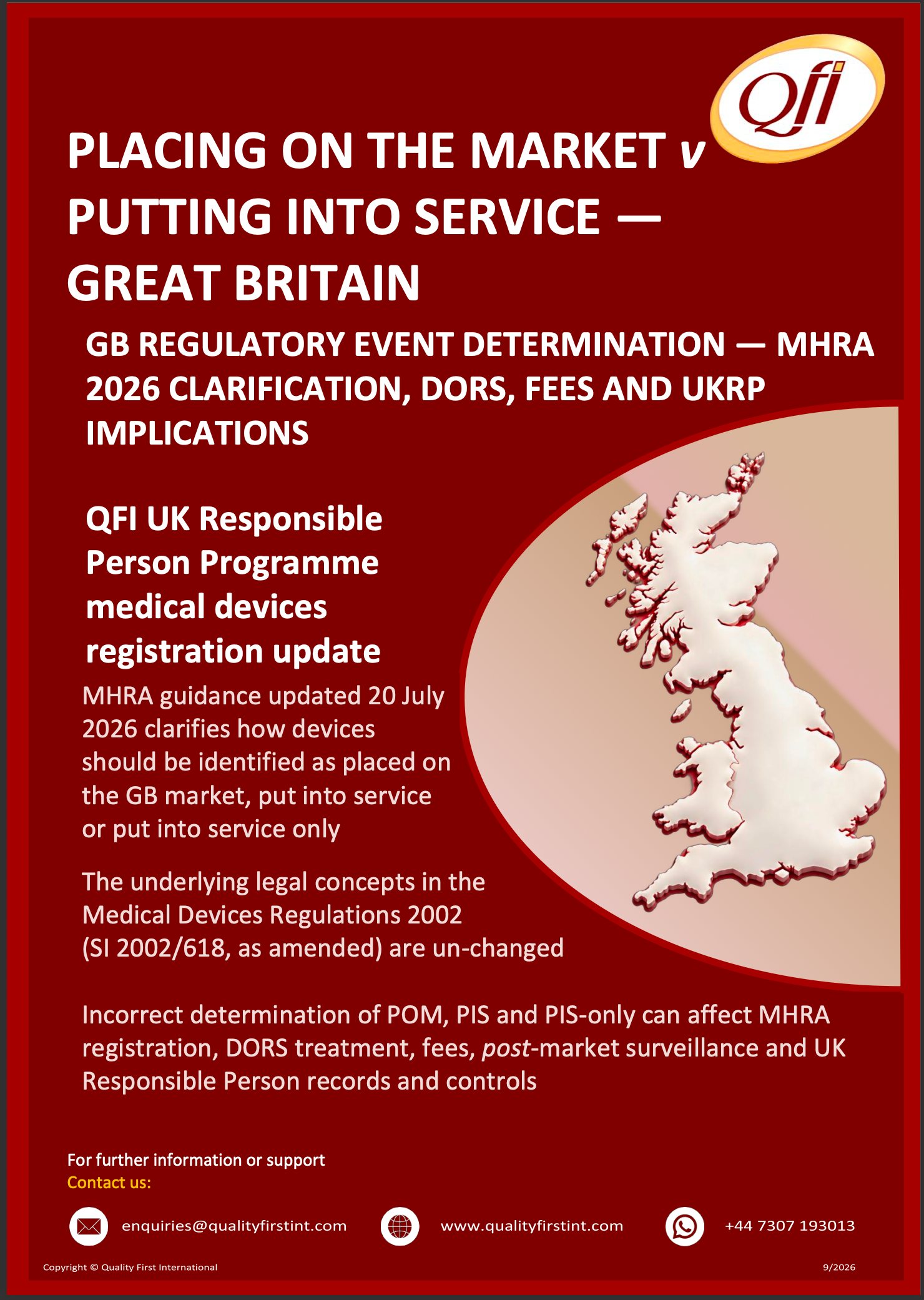
What changed on 20 July 2026?
On 20 July 2026, the MHRA updated its guidance on registering medical devices to place on the market. The update clarifies how devices should be identified as placed on the GB market, put into service, or put into service only.
The underlying legal concepts in the Medical Devices Regulations 2002 (SI 2002/618, as amended) have not changed. However, an incorrect determination can affect MHRA registration, DORS treatment, fees, post-market surveillance and UK Responsible Person records and controls.
Key facts at a glance
Guidance updated
20 July 2026
MHRA registration guidance
DORS review date
11 Sept 2026
PIS-only records
The law
Unchanged
UK MDR 2002, as amended
Applies to
GB market
medical devices
What is the difference between placing on the market and putting into service?
Placing on the market is the first making available of each new or fully refurbished device on the GB market, whether for payment or free of charge, with a view to distribution, use or both. Putting into service is, for most devices, the first making available in Great Britain to the final user, which may be a professional organisation.
Devices for clinical investigation are excluded from the ordinary definition of placing on the market. For active implantable devices, a separate rule applies to making the device available to a practitioner for implantation.
Key concepts
Placing on the market
Statutory event: first making available on the GB market
Putting into service
Statutory event: first making available to the final user
PIS-only
MHRA administrative status, not a third statutory event
What does PIS-only mean?
PIS-only is an MHRA administrative status, not a third legal event. It applies where a device has been put into service in Great Britain but no earlier qualifying GB placing on the market has taken place for that device.
A genuine example is a device manufactured and used internally, where it was never placed on the GB market first. Devices that have been both placed on the market and put into service must not be designated PIS-only.
The MHRA sets out its approach in its guidance on the registration requirements for medical devices placed on the market and put into service.
The basic GB status model
| Device history | POM | PIS |
|---|---|---|
| Development / pre-market | No | No |
| Placed, not yet available to the final user | Yes | No |
| Most market-to-use routes | Yes | Yes |
| Genuine PIS-only route | No | Yes |
Does a missing POM date mean a device is PIS-only?
No. The absence of a recorded placing on the market date does not, on its own, establish PIS-only status. The status must be supported by evidence.
Can an invoice or delivery date prove when a device was placed on the market?
Not on its own. Payment, invoices, transfer of title, customs import dates, delivery, commissioning and first patient use are all useful evidence. None of them is an automatic legal test. Labels such as "loan", "demo", "evaluation" or "refurbished" do not decide the status either.
Evidence v legal test
Useful evidence
- Payment or absence of payment
- Invoice date
- Transfer of title
- Customs import date
- Shipment or physical delivery
- Commissioning
- First patient use
- Labels: "loan", "demo", "evaluation", "refurbished"
What decides status
- POM: first making available on the GB market, paid or free, for distribution, use or both
- PIS: first making available in GB to the final user
- PIS-only: PIS has occurred with no earlier qualifying GB POM
The takeaway: evidence supports a determination, but no single document or label decides it. The full supply route must be assessed.
What about the 11 September 2026 deadline?
Under the MHRA's 2026 implementation arrangements, relevant PIS-only records in DORS (the MHRA's Device Online Registration System) had to be reviewed or updated for the 2026/27 fee recalculation by 11 September 2026. This follows the new annual registration fee introduced by The Medical Devices (Fees Amendment) Regulations 2026 (see the MHRA's fees guidance). Manufacturers who are unsure whether their records are correct should review them now.
How does QFI determine status correctly?
QFI's circular sets out an 8-step determination sequence:
- Territorial market
- Regulatory device identity
- Device state and continuity
- Complete supply route
- First qualifying GB making available
- Final user
- Putting into service
- PIS-only, further making available, or identity re-set
QFI determination sequence
- Territorial market
- Regulatory device identity
- Device state and continuity
- Complete supply route
- First qualifying GB making available
- Final user
- Putting into service
- PIS-only, further making available or identity re-set
Which situations are most difficult to assess?
The circular explains the typical issues in each of these areas:
- Capital equipment: placing on the market may happen before installation and putting into service may follow commissioning or clinical release
- Lease, loan and free-of-charge supply: title or payment is not essential to placing on the market
- Consignment: control and the right to withdraw or use the device may matter more than invoicing
- Internal manufacture and use: can support genuine PIS-only status where no earlier GB placement occurred
- Used devices: later resale or relocation is usually a further making available, not a new first POM or PIS
- Full refurbishment: can re-set the device's regulatory identity and start a new POM and PIS history
- Software and systems: identify the regulated device and whether its identity continues after a change
- Export and territories: GB, Northern Ireland, the Crown Dependencies and the Overseas Territories must be distinguished first. If Northern Ireland or the EU is in scope, our practical EUDAMED guide is a good companion read.
Who must register a device if the manufacturer is outside the UK?
A manufacturer based outside the UK must appoint a UK Responsible Person, who registers its devices with the MHRA on its behalf. Read the MHRA's guidance on regulating medical devices in the UK.
How QFI can help
With 31 years of regulatory, compliance and market surveillance expertise, QFI supports manufacturers with UK, EU, US and international requirements.
For manufacturers outside the UK, QFI can support your route to market and act as your UK Responsible Person.
QFI can also:
- Determine the POM and PIS status of individual devices and device populations
- Reconstruct and evidence historic POM and PIS chronology
- Review PIS-only eligibility and supporting evidence
- Reconcile DORS registrations and fees
- Assess complex supply models: capital equipment, consignment, lease and managed-equipment arrangements
- Assess software, accessories and system identity
- Review used, repaired, reconditioned and fully refurbished devices
- Train your team on DORS and GB national requirements
- Support remediation and MHRA enforcement matters
- Develop procedures, instructions and checklists, backed by our Quality Management System expertise
Book a free 20-minute call
Not sure whether your devices are correctly recorded as POM, PIS or PIS-only? We will review your situation and help you plan your next steps.
Contact QFI UK Responsible Person ProgrammeQuality First International. Client First, Quality Assured.

Master the new MHRA draft regulations. Learn how the latest UK rules impact medical devices, SaMD, IVD compliance, and post-market surveillance.

Understanding the EUDAMED system, meeting the deadlines and getting your data right.

London, 9 August 2024 Haroon Atchia, CEO of London-based medical device consultancy Quality First International, is proud to announce the release of his new guidance on the application of the Hazard and Operability (HAZOP) technique within the medical device industry. This comprehensive guide aims to fill the existing knowledge gap in safety and reliability engineering for medical devices by providing in-depth analysis, practical insights, and grounded-theory research. The guidance, entitled “Hazard and Operability Study for Medical Device Manufacturing: Concepts and Application”, was originally conceived as part of Quality First International’s continuing professional development programme, and is designed for technical specialists, safety assessors, inspectors, and researchers involved in medical device safety and reliability engineering. It meticulously explores the HAZOP technique, a critical tool for identifying and managing operational hazards in industrial processes. Haroon Atchia leverages his extensive experience in inspecting, implementing, and optimising medical device industrial processes, including biomaterials, non-active and active surgical implants, clean room operations, and industrial sterilisation, to present a robust framework for HAZOP in medical device manufacturing. Key Features of the Book: 1. Comprehensive Introduction to HAZOP: The book begins with an explanation of the HAZOP study procedure, detailing the analysis phases and their relevance to the medical device lifecycle. It also includes historical context and practical examples through detailed worksheets. 2. Development and Application: The evolution of HAZOP technique is thoroughly examined, with Chapter 2 highlighting significant industrial accidents that underscore the importance of rigorous hazard analysis in the medical device industry. 3. Standards and Oversight: Chapter 3 analyses an existing HAZOP standard, discussing critical aspects such as safety oversight, post-study modifications, and the integration of HAZOP with medical device risk management systems and technical reports. Author's Vision: "My intention with this book is to provide a clear, contextual understanding of the HAZOP technique and to promote its technical application, particularly in the medical device industry where operational safety is paramount," said Haroon Atchia. "This book serves as a critical resource for professionals dedicated to ensuring the highest standards of safety and reliability in medical device manufacturing." About the Author: Haroon Atchia is the CEO of Quality First International, a leading medical device consultancy based in London. With decades of experience in the field, Atchia has established himself as an expert in medical device safety and reliability engineering. His work focuses on optimising industrial processes to enhance safety and compliance in medical device manufacturing. Availability: This 74-page document is available from QFI upon request, please contact enquiries@qualityfirstint.com. Price: 89.00 GBP . A discounted price ( 15% OFF ) is offered to QFI clients. About Quality First International (QFI) QFI is a London-based medical device consulting company specialising in solving its clients’ regulatory, technical and compliance challenges to enable medical devices to enter the global marketplace. QFI provides regulatory advice, quality assurance and clinical trial services, with particular emphasis on the European, US, Japanese, Australian, Canadian, Mexican and Chinese marketplaces. QFI’s clients range from start-up companies to multinational organisations, primarily developing a broad range of cutting edge, minimally invasive and cardiovascular products and implants. QFI also specialises in various remediation and business excellence initiatives including solutions to regulatory enforcement, corporate integrity arrangements and expert witness services. For further information please contact: Tel: +44 (0)208 221 2361, Email: enquiries@qualityfirstint.com

This sector-specific compilation of changes made to the UK regulations on medical devices creates a clear and thorough consolidated version of the Medical Devices Regulations 2002 London, 02 August 2024 London-based medical device regulatory consultancy Quality First International has published a unique consolidated version of the UK Medical Devices Regulations 2002, to present clearly all amendments made to the legislation to date, excluding changes applicable only in Northern Ireland. This document is suitable for manufacturers and regulatory experts in the medical device field who wish to understand the evolution of device regulation in the UK since publication of the original Regulations in 2002, up to and including the Medical Devices (Amendment) (Great Britain) Regulations 2023. The 437-page document is available from QFI upon request, please contact enquiries@qualityfirstint.com . Price: 450 GBP – a 15% discount is offered to QFI clients. About Quality First International (QFI) QFI is a London-based medical device consulting company specialising in solving its clients’ regulatory, technical and compliance challenges to enable medical devices to enter the global marketplace. QFI provides regulatory advice, quality assurance and clinical trial services, with particular emphasis on the European, US, Japanese, Australian, Canadian, Mexican and Chinese marketplaces. QFI’s clients range from start-up companies to multinational organisations, primarily developing a broad range of cutting edge, minimally invasive and cardiovascular products and implants. QFI also specialises in various remediation and business excellence initiatives including solutions to regulatory enforcement, corporate integrity arrangements and expert witness services. For further information please contact: Tel: +44 (0)208 221 2361, Email: enquiries@qualityfirstint.com .

This sector-specific standard has been designed to help manufacturers, developers and technical assessors design, develop and evaluate medical device apps

For medical device manufacturers who want to understand the requirements of the UK’s new MHRA MORE platform for submissions of device related incidents: New WEBINAR presented by Haroon Atchia is available